


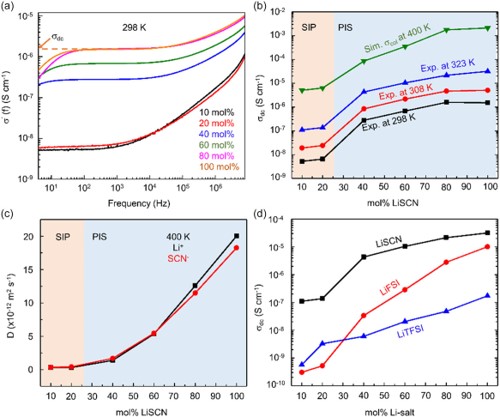
Challenging the preference for bulky anions due to low binding energy with Li+ ion, the lithium thiocyanate-polyethylene carbonate (LiSCN-PEC) solid polymer electrolyte (SPE) demonstrates higher ionic conductivities (3.16 × 10⁻⁵ S cm−1) at polymer-in-salt concentration (100 mol%) compared to those with lithium bis(fluorosulfonyl)imide (LiFSI, 1.01 × 10⁻⁵ S cm−1) and lithium bis(trifluoromethanesulfonyl)imide (LiTFSI, 1.72 × 10⁻⁷ S cm−1). Through the careful selection of PEC and LiSCN as components of SPE, the carbonyl stretching of PEC and the SCN− stretching band as vibrational reporters provide detailed structural insights into the Li+ ion transport channel. Spectroscopic investigations reveal that enhanced ion aggregation alters the solvation structure around the Li+ and diminishes the interaction between Li+ and polymer (PEC) with increasing LiSCN concentrations, promoting faster segmental motion as a major transport mechanism. However, the transition observed from subionic to superionic behavior in the Walden plot indicates the onset of segmental motion decoupled charge transport pathway. The SCN− vibrational spectrum elucidates the evolution from a Li–SCN–Li type chain-like structure to a Li2 > SCN < Li2 type extended ion network with increasing LiSCN concentration, revealing that the ion network provides an alternative channel for Li+ ion transfer at higher concentrations, enhancing conductivity.
onlinelibrary.wiley.com/doi/10.1002/smsc.202400653