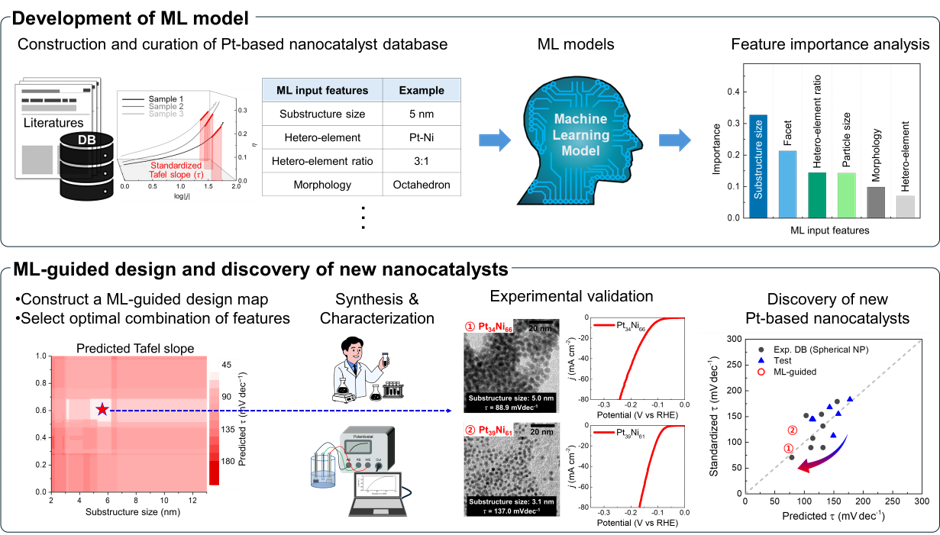


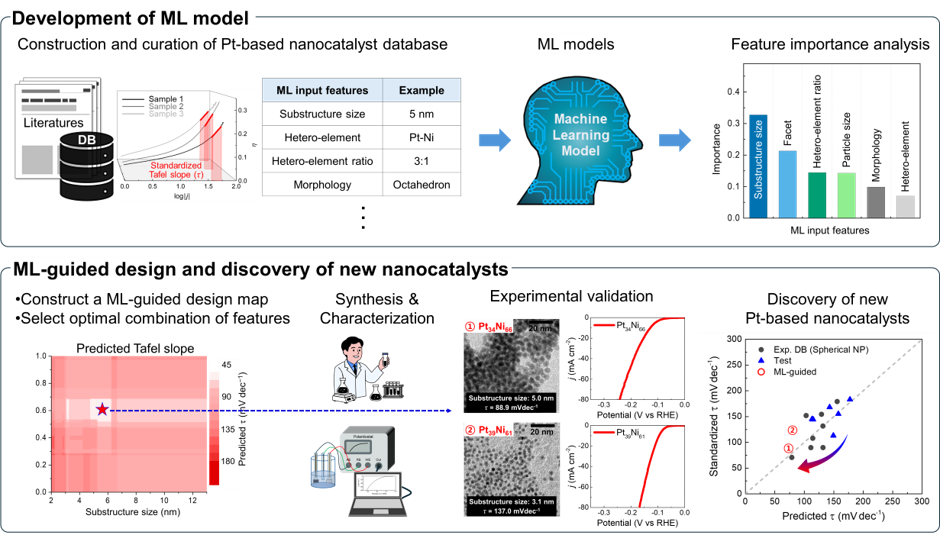

The hydrogen evolution reaction (HER) is a key process for sustainable hydrogen production, with Pt-based nanocatalysts widely used for their superior activity. However, inconsistent reporting of electrochemical properties hinders reliable evaluation and comparison of catalytic activity across diverse studies. In this study, a standardization method is established in which Tafel slopes were systematically extracted from polarization curves, enabling consistent electrochemical kinetic analysis across diverse studies. A comprehensive database of 127 Pt-based nanocatalysts from 42 published articles was constructed. Machine learning (ML) models trained on this dataset demonstrated strong predictive ability for Tafel slopes. To evaluate model generalizability, six Pt-based nanocatalysts were synthesized, where ML predictions closely matched experimentally measured Tafel slopes. Feature importance analysis revealed key structural and compositional parameters, such as substructure size and hetero-element ratio, that strongly influenced catalytic activity. Guided by these insights, an ML-guided design map for spherical Pt-based nanocatalysts was constructed. As a proof of concept, Pt34Ni66 was synthesized and exhibited a Tafel slope of 88.9 mV dec−1 which corresponded to enhanced catalytic activity compared to prior reports. This work demonstrates an ML-assisted strategy to accelerate discovery of high-performance HER catalysts, integrating data curation, ML model development, ML-guided design, and experimental validation.
DOI 링크: https://doi.org/10.1002/smtd.202501909